

Appearances – and names – can be deceptive. Unfortunately, this is not my private plane.
There are few things I enjoy less than arriving somewhere extraordinary feeling utterly ruined.
And yet, for years, that’s exactly how I arrived in Africa: bleary-eyed, dehydrated, vaguely irritable, and wondering why on earth I felt like I’d been run over by my own holiday.
This is not a piece about luxury travel, “hacks” (as regular readers know, I despise that word), or how to “beat” long-haul flying. It’s simply about how I now try to arrive feeling human — and why that took me far longer to learn than it should have.
Even when I ponied up to escape economy class…
Business class is about sleep (not champagne)
Let’s start with the uncomfortable truth.
The real benefit of business class on a long-haul flight to Africa (or anywhere) is not the food, the service, or the champagne. It’s sleep. That’s it.
You are paying for the ability to lie flat, switch off, and arrive less broken than you would otherwise. Everything else is theatre.

If you get one of these, use it properly.
Frequent business travellers understand this, but they ain’t paying for their own tickets. So what about us? The people who scrape together enough airline points – or cash – once in a blue moon to turn left at the stairs when boarding the plane? Maybe there was a special offer, your “bid” to upgrade went through or you are just plain old spoiling yourself?
The irony — and I include myself very much in this — is that when people do get upgraded, they often do exactly the opposite of what they should. They stay awake. They eat everything. They drink the champagne because, well, it’s part of the experience, right?
Who turns down caviar and bubby on boarding? And you’re paying for it, one way or the other…

OK, one glass before take-off then. Now get a grip, for goodness’ sake.
I can count the number of times I’ve flown in business class on the fingers of one hand. Of course I loved every single time. But every single time, I was shattered when I landed.
By the way, the same temptations await in those lovely lounges that you generally can access when flying business. Many have darkened, quiet rest areas with reclining seats where you genuinely can get some sleep after a warm shower.
But they also have free bars and wonderful food…
Resist!
If you can manage it, the mindset shift is simple but surprisingly hard: you’re not paying for the experience, you’re paying to sleep. Whether you succeed at that first time round is another matter entirely.
Upgrades: one leg is often enough
If you’re travelling on a multi-sector route — Europe to Africa often involves a connection — upgrading one leg can make a meaningful difference.
The longest overnight sector is usually the one that matters most. That’s where sleep pays dividends, and where being horizontal rather than upright genuinely changes how you feel the next day.
Airlines increasingly offer upgrade bidding or cash offers in the weeks before departure. Sometimes they’re good value, sometimes they’re not. I wouldn’t plan a trip around them, but they’re worth being open to.
And collect those frequent flyer points – one day you might have enough to exchange for a business class seat.
Just don’t fall into the trap of thinking an upgrade guarantees rest. It doesn’t. Behaviour still matters.
Eat before the flight (and ignore the tray)
This is the advice I give most often — and the advice I still don’t always follow myself.
On evening or night flights, particularly those departing Europe, in-flight meal service can come very late. I’ve been on flights where dinner is served well after midnight, precisely when your body would quite like to be asleep.
My strong preference now is to eat properly at the airport and then skip the main meal onboard altogether.
Yes, airline food is free. Yes, it can even be quite good. Especially in business class.
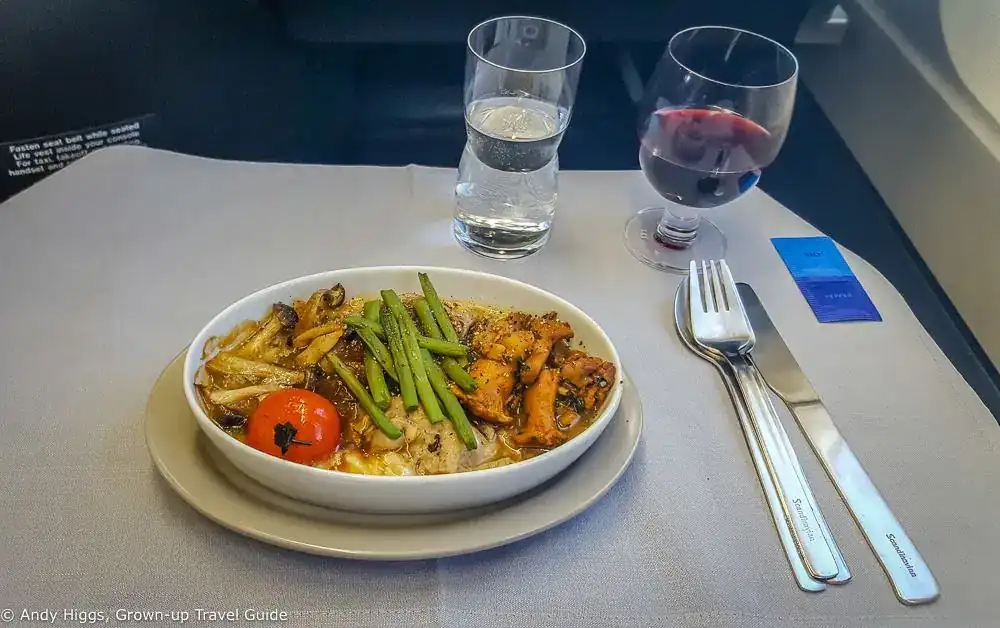
Tasty, but better than a couple of hours of sleep? Debatable.
Digestion, alcohol and sleep are not natural friends at 35,000 feet.
If you can resist the tray and the wine, you often arrive feeling markedly better for it.
Alcohol vs water (a dull but important battle)
This will surprise no one, but it bears repeating.
Cabin air is extremely dry. Dehydration makes everything worse: fatigue, headaches, irritability, jet lag (where applicable), and that faint sense of doom that can descend somewhere over the Sahara.
I now try to drink significantly more water than alcohol on long-haul flights, and I usually avoid coffee altogether.
It’s boring advice. It’s also the single most reliable way to arrive feeling better.
Fill a bottle before boarding. Ask for water whenever you think of it. You can never really have too much.
Aisle or window? I’ll take freedom, thanks
This is personal, but I’ll say it anyway: the window seat is overrated, especially on night flights.
If you’re trying to rest, being able to get up without disturbing others matters more than the view you can’t see in the dark. Chances are your neighbours will sleep like logs, and repeatedly waking them to climb over does nothing for your own comfort.
I almost always choose an aisle seat now. Freedom of movement beats aesthetics every time.
Night flights are different (and should be treated as such)
A night flight is not a floating restaurant. It’s not a cinema. It’s not a social occasion.
If you want to arrive in decent shape, it helps to treat it more like a slightly awkward night in a strange bed.
That means:
preparing what you need before take-off
accepting that “good enough” sleep is still a win
minimising screen time once the lights go down
I tend to favour audio — podcasts or audiobooks — rather than bright screens, which I find remarkably effective at keeping me awake. Others swear by films. There’s no universal rule, only what works for you.
Just download everything in advance. Discovering that your audiobook needs Wi-Fi after take-off is an avoidable low point.
The aim is not perfection
Despite everything above, I still get this wrong sometimes. I still say yes to the booze. I still eat when I shouldn’t. I still land more tired than I intended.
The point isn’t to optimise every minute of the flight. It’s simply to improve your odds of arriving feeling ready for what comes next — especially when what comes next is early starts, long days, and extraordinary places that deserve your attention.
Long-haul travel is tiring. That’s normal. But it doesn’t have to flatten you completely.
A few small choices, made with sleep rather than indulgence in mind, can make a surprising difference.
And if nothing else, there’s always the first proper coffee on African soil. That helps too.
Or beer, obviously.
